Showing posts with label India Papers. Show all posts

Friday, 27 February 2015

Butcher Birds


I found a beautiful little book in our Official Publications Indian  paper collection called "Bird friends and foes of the farmer."
The author a Mr P. Susainathan has devoted years to the observation of bird life.  In the preface it states  ”It is unnecessary to emphasize the extent to which birds affect all those engaged in farming : but apart from their importance to the agriculturist in this respect they are of absorbing interest in themselves.  We all need recreation of some kind”
I particularly like the Shrikes or Butcher-birds.  This bird impales its prey on acacia and cactus thorns before commencing to make a meal of it.  This bird is beneficial to the farmer!
Another bird is the Hoopoes which like rubbish heaps and termite mounds!  The call of this bird resembles the sound “Hoop-hoop” repeatedly.   This bird should be encouraged and protected as its love of eating insects helps to reduce the dreaded mosquito.
A bird which is also useful to the farmer and people is the vulture, in particular the smaller White Scavenger Vulture which is a foul feeder on human excreta and dead animals.  This bird should be encouraged in towns and villages.   However, the parrot family includes a number of bird-pests to agriculture which are a constant menace to standing crops!
This little book full of information and illustrations can be found at IP/25/AD.1.

Thursday, 28 March 2013

Meet me and my microbes

Wednesday 10th April is when I will be giving my final talk dedicated to the fine collection, the Medical History of British India. Exploring the more gruesome aspect of life in British India, the talk explores the diseases the British attempted to combat and how their medicine moved into the lives of the indigenous population. Come along to the National Library of Scotland on George IV Bridge at 6pm and meet me and my microbes! Book online here. It is a free event.

Shot in the arm for Medical History website

A new collection of medical documents from the British Raj is now available to browse and search on the Medical History of British India website. 'Medicine - Vaccination' shows British efforts to vaccinate the Indian population against smallpox using the latest 19th and 20th century western scientific techniques. Over 60 reports reveal the complex nature and the scale of ambition of the vaccination programme in India as well as the conflict between western colonial medicine and indigenous society, culture and systems. The project was generously funded by a grant from the Wellcome Trust.

Thursday, 7 March 2013

Farewell to India

After five and a half years I’m hanging up my Digitisation Manager’s hat and saying goodbye to the Medical History of British India.

I’ve had a brilliant time and have been privileged to work with such amazing material and a group of very talented colleagues across the National Library. Special thanks must go to the procurement staff and the Digital Team, plus to Jan Usher who was one of the co-founders of the project.

I’ve been to some great places to talk about the project, including the Wellcome Collection in London and Brisbane, Australia, and have met some wonderful researchers along the way.

Most of all, I have been immersed in a world long gone but preserved in our reports, British India. I have met doctors and patients, pioneers of medicine, witnessed the horror of death and disease and the role of medicine in colonial power. From prostitutes who lived in rum barrels, to bowel gangs and rabid badgers, medical students, veterinarians and lunatics, it has been a colourful experience!

These reports are all still available for free on the website and on April 10th I will be giving a talk called Painful Tales from the Raj at the National Library’s George IV Bridge Building at 6pm.


I’m doing another podcast on the asylums and mental hospitals and will be promoting the vaccination reports which are due online next month.

I have a new post as Digital Projects Officer, still in the NLS, working to bring more of the Library’s collections online.

The Library is applying for more funding to add further reports to the website so this may not be the end of the journey….


Tuesday, 4 September 2012

Mental Health reports added to Medical History of British India website

Those of you who regularly read this blog will know that I have been working on the digitisation of lunatic asylum reports from British India for some while.

I am delighted to announce that they have been added to the Medical History of British India website as the 'Medicine - Mental health' collection.

The 20,000 pages cover the period of 1867 - 1948 and describe the patients, staff and conditions of asylums throughout colonial India. This free to access material provides extensive research on responses to mental illness when the asylum's role was changing. Detailed reports show how 'moral management' was used by British colonists to treat native and European patients. This material will be particularly valuable to genealogists and those interested in the history of psychiatry, Indian and colonial history.

Please do have a browse and remember that the reports are searchable; just click on 'include book content' when you search.

The material, from the National Library's India Papers collection, was microfilmed and digitised using a grant from the Wellcome Trust.


(Picture shows Block plan of Rangoon Lunatic Asylum from 1893, image number: http://digital.nls.uk/83977693)

Thursday, 26 July 2012

Great British bed bugs

In the build-up to the London Olympics, with the invasion of Union Jacks, adverts for sport gear and energy drinks, have you considered another invasion - of bed bugs?

The Australian bed bug epidemic was most likely to have been caused by the mass influx of visitors to the Sydney Olympics in 2000. Now London is bracing itself not only for a year's worth of tourists in 3 weeks but a surge in the bed bug population.

Bed bugs are wingless insects which are transferred from place to place by crawling into clothes and luggage. They can hide in mattresses, bed frames and even clock radios. They thrive in densely packed cities and feed on human blood. Infestations can be dealt with by pest control experts who deploy steam and chemicals against the unwanted insects.

Buyers of secondhand furniture are advised to check all items for bugs very carefully and travellers asked to check hotel beds and headboards while keeping luggage off the floor.

In British India it was suspected that the bed bug caused leishmaniasis, such as in Preliminary report on the development of the Leishman-Donovan body in the bed bug, 1907.

Medical personnel deliberately placed bed bugs on patients who were lying prostrate with malaria as part of their experiments.

In nineteenth century Bengal, bed bugs were a threat to army health as well as causing uncomfortable nights' sleep for the soldiers as they were feared to carry disease-causing parasites.

Europeans were advised to copy the Mahomedans, who shook the bugs out of their beds just outside the house or the Hindus who placed wooden bug traps in their beds.

Thursday, 16 February 2012

CSI: India


I’ve been looking at the Chemical Examiner’s reports, which are among the remaining medical items in the India Papers. The NLS plans to put in a bid to the Wellcome Trust to have these digitised and added to the Medical History of British India website. The NLS holds reports dated 1874-1942 from the Punjab, Burma and North-West and Central Provinces and Oudh.

The Chemical Examiners gave independent scientific advice to the Criminal Justice Administration System. The first laboratory was established in Madras in 1849, with one formed in Kerala in 1890 under the orders of Government as part of the Health Department.

The Chemical Examiner’s laboratory investigated cases of human and animal poisoning, stain cases (blood, semen, faecal matter) plus purity of drugs (opium, hemp drugs, cocaine, chloroform) and water.

The reports include short notes on the more important medico-legal cases, including strychnine poisoning and a case of an apple tart laced with croton oil, a ‘drastic purgative.’ The cook had poisoned the tart, which was served up after a cantonment dinner party (Report of the Chemical Examiner to Government, North-West Frontier Province, 1930, shelfmark: IP/29/CB.3).

Hair was also used to detect crime, examined by microscope and ultra-violet light to identify its origin. The work of the American scientific crime detection lab in North-Western University was of interest in India as ‘hair-rings’ could show the age of a human. Hair was as important as a finger-print in tracing criminals, Dr. Hood claimed.
(Report of the Chemical Examiner to Government, North-West Frontier Province, shelfmark: IP/29/CB.3).

The Chemical Examiner’s Laboratory still exists at Kerala and its work is very similar to that of last century.

(picture credit: www.cartoonstock.com)

Tuesday, 10 January 2012

War Horse, Army Donkey, Military Mule


I was pleased to be alerted to this blog entry which features a National Library of Scotland photograph.

The photograph, taken during World War I, shows a man with his arm around a mule . On the back he has written about his animal companion: "She is very stupid but I am very fond of her."

Michael Morpurgo's 2007 moving book War Horse is due out as a Steven Spielberg film this month. It tells the story of farm horse Joey's journey through the battlefields of the First World War.

Morpurgo was inspired to write the book after reading that millions of horses perished on the Western Front. Used in the thick of battle in cavalry charges and for pulling artillery, horses, mules and donkeys were seen as more reliable than
mechanised means.

Horses were very important in British India for the same reasons. The National Library's Medical History of British India website contains many digitised reports dedicated to the procurement of suitable breeding horses for serving the army. Horses imported from England often sickened and died en route. Those which survived were found to be unable to stand hard work in a tropical climate. In 1892 it was recorded that Indian-bred horses were hardier, with greater powers of endurance. Arab and Persian breeds had the same sought-after traits.

Horses, donkeys and mules who served in India, like their human counterparts perished from a variety of ailments and afflictions as this page shows.

Perhaps Michael Morpurgo would consider writing a book about one of these animals?

(Photograph is from the National Library of Scotland's Digital Gallery, First World War Official Photographs collection, image number 74549584)

Monday, 19 December 2011

Veterinary medicine reports now available for free


I'm delighted to announce that 146 volumes of Veterinary medicine reports are now available on the Medical History of British India website. Click here to browse and search 40,000 pages for free.

The Veterinary collection covers 1864-1959, focusing on veterinary diseases, colleges and laboratories and Civil Veterinary Departments. This free to access, important material provides extensive research on animal diseases such as surra and rinderpest. Detailed reports show how veterinary medicine was used by the British colonists to control disease, maintain livestock and alleviate famine and its effect on military and local communities.

Illustrated with many photographs, maps and charts, this material will be useful to those interested in veterinary science, military medicine, animal husbandry and agriculture.

A new viewing function enables up to 30 pdf pages to be selected and then 'stitched' together for easier reading.

The material, from the National Library's India Papers collection, was microfilmed and digitised using a grant from the Wellcome Trust.

(Picture is from the Indian Journal of Veterinary Science and Animal Husbandry, volume 10, 1940, part I. Image number: http://digital.nls.uk/75248387)

Tuesday, 6 December 2011

A dedicated Medical History of British India blog

The National Library of Scotland is now hosting a blog solely dedicated to the Medical History of British India Online project.
The blog will cover topics such as digitisation issues, updates of the project's progress in microfilming, digitisation and OCR, medical history and modern health issues and India.
The Wordpress blog appears here on the Medical History of British India website and is listed here on the NLS blogs page.
The blog also features pages about the current specifications for the project which may be useful to those involved in digitisation projects.

Comments about the project and blog are most welcome!

Friday, 22 October 2010

I see the bad moon arising


As part of my India Papers digitisation job I quality check digital images and microfilm; yesterday I came across a couple of interesting pages from a lunatic asylum in Bengal, 1868.
The author was investigating the influence of climate and lunar phases on insanity. His experiment showed that the “waning moon had more apparent influence on the insanes than the waxing moon; but this can only be accidental, for though her face is less visible, she is still in her place in the heavens, and her attractive power (if any) must still be exerted; and that she really exerts no influence whatever.” The page shown is the table of results on which the author based his conclusion, which states at the head of the page “that there is no such person as a lunatic.” (Click on image to enlarge)


Full moons have long been associated with insanity, hence the term “lunatic,” borrowed from the Latin “lunacus.” In India patients with mental illness were known as “lunatics” or “insanes” until the 1920’s. This preceded the UK Mental Treatment Act of 1930 which changed the term to “person of unsound mind.”
Today, scientists are still researching correlations between illnesses such as schizophrenia and epilepsy and the full moon period. The police are also studying the influence of the moon on violent and criminal behaviour.
The next full moon is tomorrow, 23rd October, so perhaps we should take note of the Creedence Clearwater Revival song....

(Moon photo credit: www.commons.wikimedia.org)

Monday, 18 October 2010

Another virus eradicated


A few days ago a joint FAO/OIE announcement astounded me.
Rinderpest, a devastating cattle plague, is set to become the first animal virus to be globally eradicated by man. Although it does not infect humans, the virus can wipe out entire livestock herds in days. This has caused famines for many centuries throughout the world.
I first heard of it when working on the digitisation of the India Papers veterinary material; the first book to be scanned was the Report on the Calcutta epizootic or cattle disease of 1864 in Calcutta and its neighbourhood. In Britain 400,000 cattle perished in the Great Cattle Plague of 1865-67 when rinderpest entered the country from the Baltic.
It is clear from the Indian veterinary reports that rinderpest was a serious threat to the Government cattle farms, established to provide dairy products to the colonial army. However, the mid-nineteenth century witnessed a revolution in health sciences, and veterinary science played a key role. The rinderpest virus was discovered in Turkey in 1902 by Nicolle and Adil-Bey.
The Indian Journal of Veterinary Science and Animal Husbandry (1931-1959) is a fine example of the extensive bacteriological study of animal diseases. Understanding and preventing rinderpest was begun by scientists long ago; it is amazing to consider that, like smallpox, this virus is no longer at large.

(Picture is a typical plate from the Indian Journal, showing examples of Indian cattle.)
The Medical History of British India web feature will be updated in 2011 with over 35,000 pages of veterinary reports.

Friday, 23 July 2010

Read all about us!


The Summer 2010 issue of the NLS magazine, Discover NLS, sees OPU staff busy promoting some of our fascinating and varied collection.
In "Professional Practice" Catherine Davies tells how she is cataloguing and promoting our League of Nations material and explains more about the founding of the League.
I have written a four page article about the Medical History of British India, exploring the content of some of our candid and astonishing India Papers.
Meanwhile in the News section, Jan Usher reports back on her latest visit to Kolkata where she continued to forge links with the National Library of India.
The magazine is available in the Library, or by post or online.
Happy summer reading!

Thursday, 22 April 2010

Hopetoun House


I went for a visit to Hopetoun House (Edinburgh) on the first day of its seasonal re-opening. The estate is one of the most beautiful I’ve seen so far, not only in Scotland but, I would say, in Europe. There’s so much to enjoy: the remote and quite location -between the waterfront and the country side- helps to create a special and solemn atmosphere before leading you to the magnificent and elegant architecture from the 18th century. The grounds are designed as a traditional British park, that leaves space to nature: long, wide fields of green grass, spaces open to the wonder of the eyes, tall ancient trees that reach the sky. It is a space to be walked slowly in silence, a space for contemplation: the yellow narcissus growing here and there, the sound of the tall fountain –visible from most of the windows of the House- will lead you. The interiors are not simply aristocratic: they are put together with a rare sense of beauty and wellbeing that permeates the space. Every room has a little treasure to offer to the visitor: this could be an ancient cot, a gorgeous embroidery, a marble fireplace with wonderfully sculptured figures, or maybe a carved wooden staircase, that draws your eye to one of the few Baroque ceilings existing in Scotland. A very special art piece sits quietly in one of the public rooms downstairs, “The Adoration of the Shepherds” by the Rubens School: although most of the surface was probably painted by his helpers, some attitudes and shapes of the characters carry the distinctive mark of the Master, creating the magic that hypnotises you in front of the big canvas. Good tours are offered for those who want to know more, the guides are enthusiastic and very keen on answering every question you might ask. They suggest, and give permission, to wander around the House on your own, after the guided tour, and this was in fact a very good idea: I could have a closer look at a wonderful picture of two tigers drinking on a river side, embroidered in silk.
I took more time to browse the lovely library, full of ancient publications, and I also found some surprises:
- first of all a wonderful collection of ancient literature: Greek historians and poets find their place near Latin authors.
- a masterpiece of Italian Linguistics, the very first “Dictionary of Italian Language” (“Vocabolario degli Accademici della Crusca”), published in 1612 by the Crusca Academy, that officially established the rules for modern Italian and is to these days a very important Institution. The copy at Hopetoun House is dated 1623 on the spine, underneath the title, but I don’t know whether this is an original edition or a much later copy. This Dictionary served as a model for the first English, German, French and Spanish Dictionaries.
- last but not least a good selection of Official Publications, their presence probably represents the interests and official role of the family during the ex British Empire: Victor, 8th Earl and 2nd Marquess (1887-1952) was civil Lord of the Admiralty from 1922 to 1924. He chaired the Royal Commission on Agriculture in India from 1926 to 1928. In 1928 he was made a Knight of the Order of the Thistle. He chaired the committee on Indian constitutional reform in 1933 and helped formulate the Government of India Act of 1935. Following his experience in India he returned there as Viceroy and Governor General from 1936 to 1943, almost two full terms of office, making him the longest-serving Viceroy. Some of the Australian titles I could spot are “The Debates of the Australian Federal Convention” and “The Catalogue of the Parliamentary Library of Queensland”. Even more interesting for us the presence of Indian Official Publications, published by the Royal Commission on Agriculture in India and also by the Joint Committee on Indian Constitutional Reform. Also worth mentioning are the volumes published by Her Majesty’s Stationery Office “India: The Transfer of Power 1942-7”.
The Library (and Archives) have been put together by generations of the Hope family, who have lived here since Hopetoun was first built (1699). There is a catalogue of the Library, and some cataloguing of the Archive (which was carried out in bundles by the NLS some years ago). Both the Library and Archives are available for consultation, by appointment through the management office (enquiries@hopetoun.co.uk).
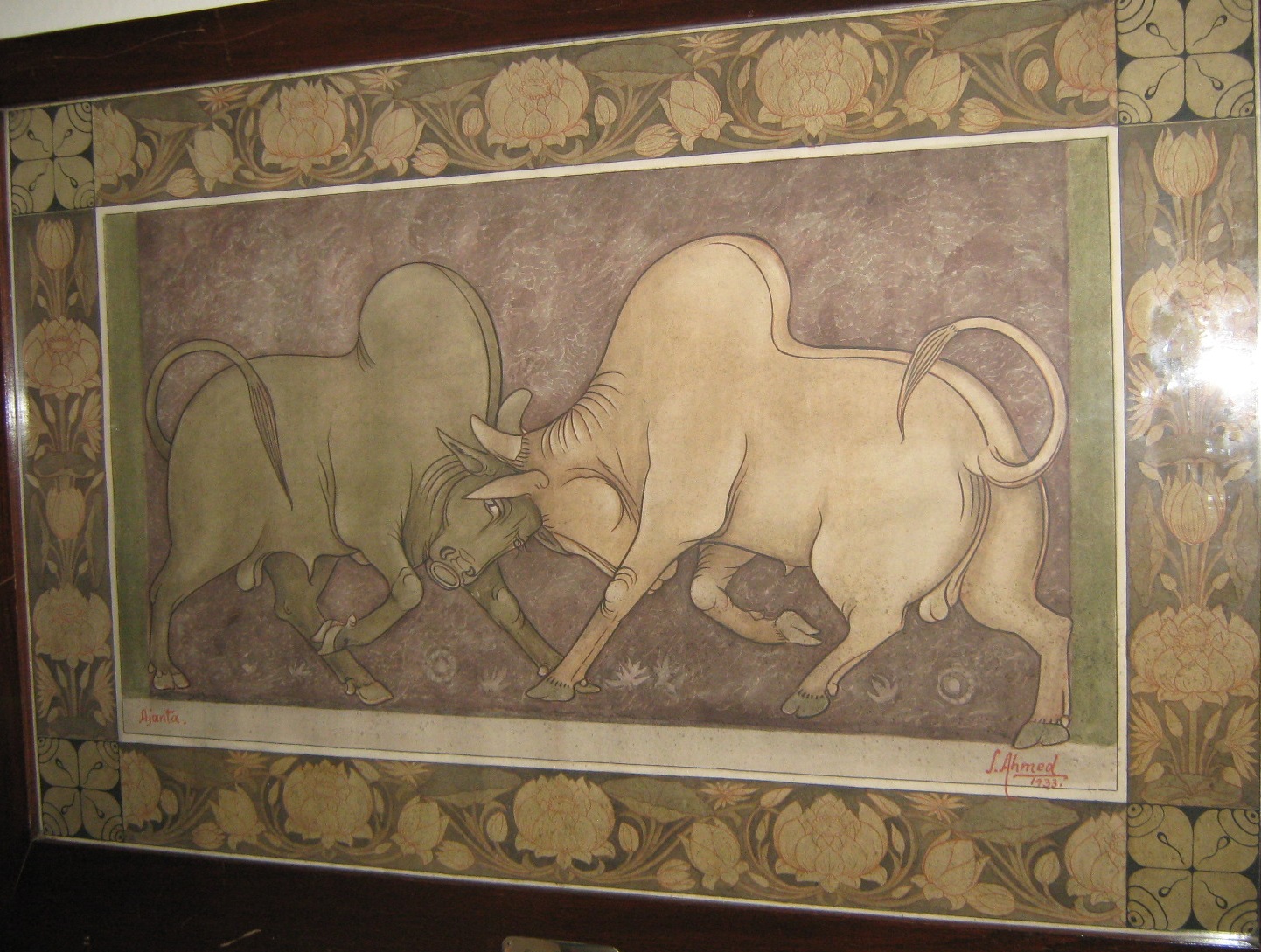
I will end by mentioning an Indian picture hang in a corridor: two bulls are fighting surrounded by a gorgeous border of water lilies, the image was probably originally created by Ajanta and copied here by S. Ahmed in 1933.

Friday, 29 May 2009

It shouldn't happen to a vet


I’ve just read The Several lives of a Victorian vet by Jean Ware and Hugh Hunt, covering the career of Griffith Evans.
Evans arrived in Bombay in 1877 at the instigation of Queen Victoria’s Principal Veterinary Surgeon, and began work on anthrax at Sialkot. He was the first man to diagnose the disease in India and went on to discover the pathogenic trypanosome which caused the disease surra (meaning “gone rotten”). In 1880 he wrote his Report on surra disease, but his colleagues regarded him as a “crank”, and the Governor-General lamented that Evans had not managed to find a cure in the 4 week period he’d been given to research the disease.
Evans’ hope of being promoted to Principal Veterinary Surgeon of India was dashed when he was effectively banished to Madras.
Evans was serving as a Veterinary Surgeon in poor, hot conditions and trying to promote his findings on surra. Evans describes his daily work in trying to locate the surra parasite, “I had to work with the microscope for many hours a day out-of-doors at the sick lines, or else in a stable, when the thermometer was 82 degrees within a cool bungalow, and the sun pouring down its rays through a cloudless sky…very few investigators know what that means.”
However in the early 1880’s John Henry Steel (pictured courtesy of BVC), of Bombay Veterinary College, hailed Evans as the discoverer of the surra microbe. Abroad, Pasteur and Koch had also taken notice of Evans’ work and in 1883 Evans was promoted to Lieutenant Colonel, leaving India a year later. Steel’s own report on a fatal disease among transport mules in Burma contains Evans' original surra findings and is part of the Veterinary project I am working on.

Friday, 23 January 2009

Louis Pasteur


Following my last post about Robert Koch's visit to India in 1897, I have been reading about another world renowned scientist's contribution to veterinary medicine. Louis Pasteur (1822-1895, pictured) is credited with discovering that microbes cause disease and is admired still for his pioneering work in microbiology. The French scientist began studying anthrax and fowl cholera in the late 1870's. Inspired by Jenner's inoculation against smallpox, Pasteur weakened (attenuated) the fowl cholera bacteria and created a vaccine that prevented animals contracting the disease.
In 1855 his rabies vaccine was tested on 9 year old Joseph Meister who had been bitten many times by a rabid dog. The boy lived and the vaccine was another one of his achievements that saved millions of human and animal lives.
Rabies features heavily in the Medical History of British India Project as it infects both animals and humans. Notable volumes I have worked with include:
Sir David Semple's work in India on his 1911 vaccine
Pasteur Institute at Kasauli
Pasteur Institute of Southern India
Various articles featuring in the Indian Journal of Veterinary Science and animal husbandry
Plus a recent book (2007) on rabies in Britain Mad Dogs and Englishmen

There is no doubt that both Koch and Pasteur were brilliant scientists, but there are also many more who did important work in the field of microbiology and veterinary medicine. I will be writing about those I have found in the veterinary volumes in the coming weeks.
Picture of Pasteur holding eyeglasses credit: Wellcome Images.

Tuesday, 18 November 2008

Influenza in India 1918

While I was working in the stacks on the India Papers Collection I had a look at some of the Sanitary Commissioner's annual reports from 1918, when influenza swept the world and killed millions. Thousands were killed in the Madras Presidency; in some districts as many as between 30-50,000 people. One problem was the superstitions of the people, particularly in rural areas:"Several people, mostly in the interior, were averse in the beginning to resorting to a medical treatment under a superstitious belief that the epidemic was a visitation of the Goddess or Amman and that no treatment by drugs should be attempted." (Annual report of the Sanitary Board, the annual report of the Sanitary Commissioner and the annual report of the Sanitary Engineer, Madras 1918)
Meanwhile the European Army in India had 19,308 men admitted to hospital and 775 deaths. As in the rest of the world, the second wave in autumn 1918 caused high mortality amongst sufferers.

Friday, 24 October 2008

Medical History of British India Project on microfilm

All 136 volumes from the Medical History of British India project Phase 2 have all been microfilmed and are available to view at the Library. To view what’s on each reel, including Phase 1, enter Mf.IP in the search box on the main NLS catalogue and then select the shelfmark option. The volumes themselves will be returning to the shelves by the end of November; some will be undergoing conservation treatment first, however.
The digital images are undergoing renaming, sorting and conversion to Jpeg format. Then they will be processed by Optical Character Recognition (OCR) so that you can fully search them when they are online next spring . I can’t wait for that, especially to look for names of Indian Medical Service officers.

Wednesday, 15 October 2008

Mad dogs and elephants


I have just started adding metadata for each volume of the Veterinary medicine material (from the India Papers), which forms Phase 3 of the Medical History of British India project. These 146 volumes will be online in late 2009. The first batch is about veterinary diseases and includes books on elephants. Elephants were used in India in the timber trade and also for transporting goods. It was vital that these animals, like many others employed by the government or army, were kept in good health, and these books give much detail about care and handling of elephants as well as how to treat elephant diseases. I wasn't aware until recently that elephants could contract rabies. Here is an account of a rare incident from A treatise on elephants by G.H. Evans (1901):"A mad dog, about five years ago, appeared in the elephant lines at Hyderabad. During the night it attacked an elephant when asleep and bit it on the trunk. The bite marks having been distinctly observed the next day, a little oil was applied, but nothing more was done and nothing particular occured till a month after the bite. During the first three days the [elephant] took food, ratib, and water, but afterwards took nothing. It did not appear to be afraid of water, as it drew it into its trunk and squirted it about, but did not drink any. It continued furious for two days, not allowing even the mahout to approach, after which it fell down and died suddenly."
The picture above shows "probably one of the finest workers in the Province [Burma]" and comes from the same volume. It appears as though this elephant was nearing the end of his life, which could have spanned eighty years or more.

Monday, 13 October 2008

You give me fever...


I heard on the World Service news over the weekend that an international team of scientists have deciphered the genetic code for Plasmodium vivax, one of the four parasites which cause malaria. This is said to be a huge breakthrough in understanding the life cycles in both mosquitoes and humans and could lead to "malaria-resistant" mosquitoes in the future.
Looking back to early research on malaria, it was Ronald Ross(pictured,1857-1932), who joined the Indian Medical Service in 1881, who made the discovery in August 1897 that malaria was transmitted through the bite of an infected mosquito. He was awarded the Nobel Prize for Medicine in 1902. You can read two volumes by Ross here on the Medical History of British India web feature