Thursday, 22 April 2010

Hopetoun House


I went for a visit to Hopetoun House (Edinburgh) on the first day of its seasonal re-opening. The estate is one of the most beautiful I’ve seen so far, not only in Scotland but, I would say, in Europe. There’s so much to enjoy: the remote and quite location -between the waterfront and the country side- helps to create a special and solemn atmosphere before leading you to the magnificent and elegant architecture from the 18th century. The grounds are designed as a traditional British park, that leaves space to nature: long, wide fields of green grass, spaces open to the wonder of the eyes, tall ancient trees that reach the sky. It is a space to be walked slowly in silence, a space for contemplation: the yellow narcissus growing here and there, the sound of the tall fountain –visible from most of the windows of the House- will lead you. The interiors are not simply aristocratic: they are put together with a rare sense of beauty and wellbeing that permeates the space. Every room has a little treasure to offer to the visitor: this could be an ancient cot, a gorgeous embroidery, a marble fireplace with wonderfully sculptured figures, or maybe a carved wooden staircase, that draws your eye to one of the few Baroque ceilings existing in Scotland. A very special art piece sits quietly in one of the public rooms downstairs, “The Adoration of the Shepherds” by the Rubens School: although most of the surface was probably painted by his helpers, some attitudes and shapes of the characters carry the distinctive mark of the Master, creating the magic that hypnotises you in front of the big canvas. Good tours are offered for those who want to know more, the guides are enthusiastic and very keen on answering every question you might ask. They suggest, and give permission, to wander around the House on your own, after the guided tour, and this was in fact a very good idea: I could have a closer look at a wonderful picture of two tigers drinking on a river side, embroidered in silk.
I took more time to browse the lovely library, full of ancient publications, and I also found some surprises:
- first of all a wonderful collection of ancient literature: Greek historians and poets find their place near Latin authors.
- a masterpiece of Italian Linguistics, the very first “Dictionary of Italian Language” (“Vocabolario degli Accademici della Crusca”), published in 1612 by the Crusca Academy, that officially established the rules for modern Italian and is to these days a very important Institution. The copy at Hopetoun House is dated 1623 on the spine, underneath the title, but I don’t know whether this is an original edition or a much later copy. This Dictionary served as a model for the first English, German, French and Spanish Dictionaries.
- last but not least a good selection of Official Publications, their presence probably represents the interests and official role of the family during the ex British Empire: Victor, 8th Earl and 2nd Marquess (1887-1952) was civil Lord of the Admiralty from 1922 to 1924. He chaired the Royal Commission on Agriculture in India from 1926 to 1928. In 1928 he was made a Knight of the Order of the Thistle. He chaired the committee on Indian constitutional reform in 1933 and helped formulate the Government of India Act of 1935. Following his experience in India he returned there as Viceroy and Governor General from 1936 to 1943, almost two full terms of office, making him the longest-serving Viceroy. Some of the Australian titles I could spot are “The Debates of the Australian Federal Convention” and “The Catalogue of the Parliamentary Library of Queensland”. Even more interesting for us the presence of Indian Official Publications, published by the Royal Commission on Agriculture in India and also by the Joint Committee on Indian Constitutional Reform. Also worth mentioning are the volumes published by Her Majesty’s Stationery Office “India: The Transfer of Power 1942-7”.
The Library (and Archives) have been put together by generations of the Hope family, who have lived here since Hopetoun was first built (1699). There is a catalogue of the Library, and some cataloguing of the Archive (which was carried out in bundles by the NLS some years ago). Both the Library and Archives are available for consultation, by appointment through the management office (enquiries@hopetoun.co.uk).
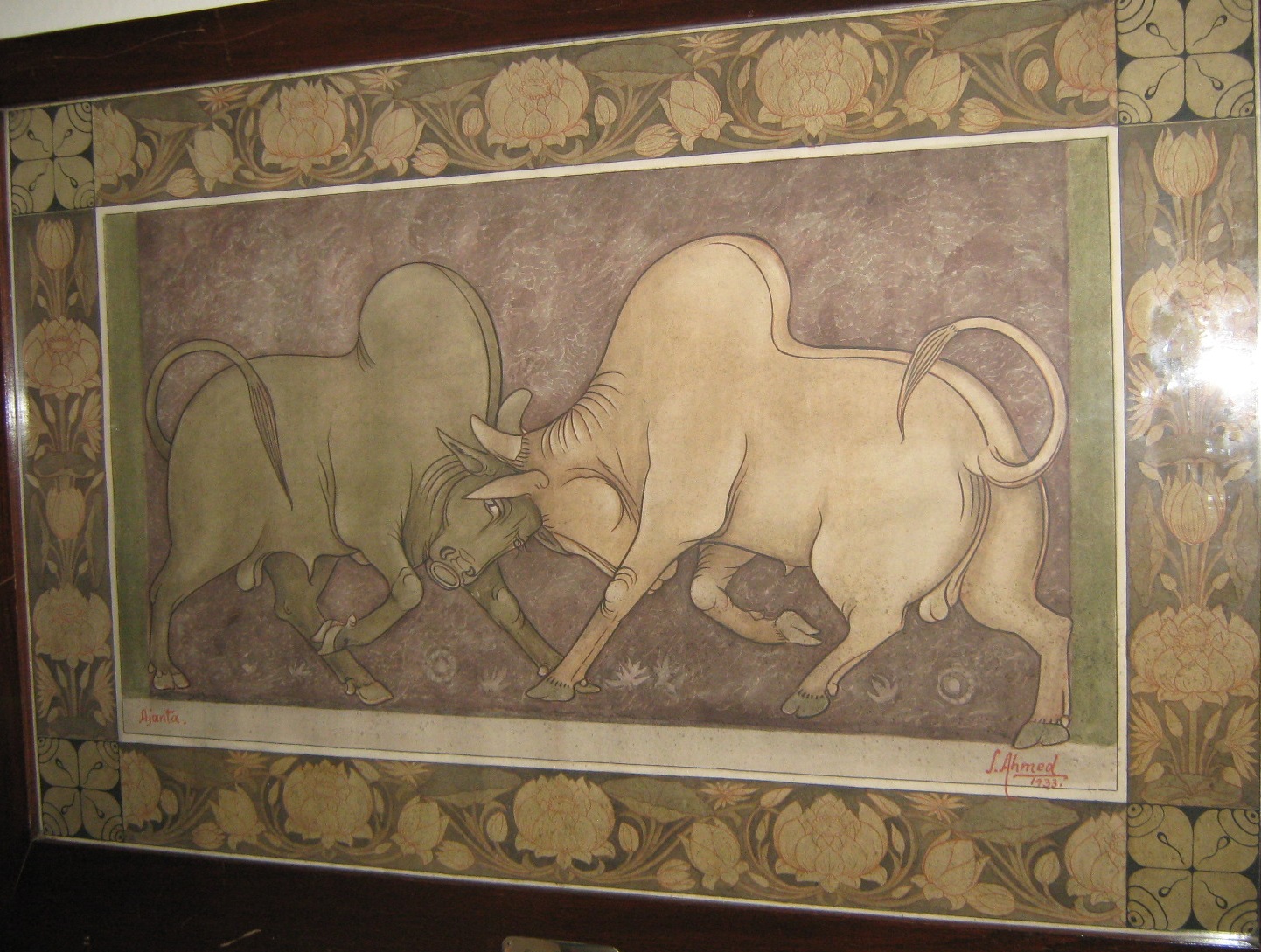
I will end by mentioning an Indian picture hang in a corridor: two bulls are fighting surrounded by a gorgeous border of water lilies, the image was probably originally created by Ajanta and copied here by S. Ahmed in 1933.

Tuesday, 20 April 2010

Joy and insanity in late 19th Century India


Today I have been generating metadata for the Lunatic Asylum annual reports of Madras, 1877-1891 which will be digitised over the summer. Reading the reports more closely is a favourite part of my job.
These present interesting details of how mental illness was treated in British India at the time. The causes of insanity were divided into two main groups, physical and moral.
Physical causes included narcotic drug use, epilepsy, fever, concussion, privation (deprivation) and over-study. Grief, love and jealousy, disgrace, fear, religion and vicious habit were listed as moral causes (1882-83).

Treatment of patients (typically called lunatics or insanes until around the 1920s)emphasised "occupation, out-door exercises, good food, occasional recreation and at all times careful supervision." (1881-82, W.R. Cornish, Surgeon-General).
Occupations consisted mostly of gardening and growing food, making mats and baskets for income generation, plus upkeep of asylum grounds and clothing.

Medicinal remedies are few, as A.N. Rogers Harrison wrote in 1881: "Little specific value is attached to the curative properties of medicines...however, opium and its derivatives, bromide of potassium, hydrate of chloral...together with counter-irritation and the cold and tepid baths are all remedies that have proved of distinct service."

The image of a chained or straight-jacketed Victorian inmate is dispelled when reading these reports. Indeed, "There is no restraint during the day, however violent the patient may be; these are simply watched. At night the noisy, violent, filthy are placed in cells by themselves." (H.D. Cook, 1881)

Funds were set aside for amusements, as in 1882: "At Christmas there was the usual treat, with sport, fireworks and a band. If this concentrated joy were distributed through the year, it would do more good. Native music, sweets, jugglers and a few fireworks once a month would, at a cheap rate, give pleasure to many." (S.L. Dobie)
I will be comparing these approaches with later ones as I go through the Mental Health collection, which dates to around 1940.

(picture credit: Wellcome Images, showing Lawrence Asylum, Ootakamund, Madras (1873) and Small images of men and children, all of whom show signs of insanity (undated))

Monday, 19 April 2010

Eyjafjallajokull's volcanic ash plume - did you know...?


...that the Met Office is one of 9 Volcanic Ash Advisory Centres VAACs) around the world responsible for advising international aviation of the location and movement of clouds of volcanic ash? It's also one of only two World Area Forecast Centres ,or WAFCs, (the other is in Washington D.C.) which uses data to fulfil Annex 3 of the ICAO Convention on Civil Aviation forecasting upper level winds and temperatures to enable the most efficient use of aircraft fuel.

With Eyjafjallajokull still erupting and arguments over whether or to reopen the skies to flights, it's worth having a look at the International Federation of Airline Pilots' Association's (IFALPA) scarey but informative video of what happens to a 'plane if volcanic ash enters the engine casings...

Monday, 12 April 2010

Beware of the wrong holiday souvenirs


I listened to this Medical Matters podcast today, about parasites which can invade our bodies.
Three of them feature heavily in the Medical History of British India project - malaria, leishmaniasis and schistosomiasis. Far from being diseases from remote jungles or only threatening to health 100 years ago, these can be caught on foreign holidays today.
Make sure that you don't bring home a dangerous souvenir by checking out travel advice from your local GP or from the NHS fit for travel site.

There is an article in the latest issue of Wellcome History magazine about the discovery of the cause of Oriental sore, or cutaneous leishmaniasis.

(Photo of leishmaniasis parasite from www.bbc.co.uk)

Friday, 9 April 2010

The discovery of the jungle


A first edition of The Jungle Book, complete with a handwritten inscription by author Rudyard Kipling to his youngest daughter, has been discovered in a National Trust property in Cambridgeshire. Inscribed "This book belongs to Josephine Kipling for whom it was written by her father, May 1894", the book was found in the library of Wimpole Hall in a collection belonging to Kipling's second daughter Elsie Bambridge, who lived in the property between 1938 and 1976. She brought many of her own books with her, as well as those of her husband, mother and father. Josephine Kipling died of pneumonia aged six, five years after her father dedicated the book to her. "This inscription is very touching, especially when you consider that Kipling lost not only Josephine, but also his youngest child, John, who died in the Great War," said Wimpole Hall curator Fiona Hall. "As Kipling's only remaining child, Elsie would have really treasured this book." Josephine Kipling's copy of The Jungle Book came to light following a three-year project to catalogue the Wimpole Hall library. Although the inscription is unsigned, the handwriting, based on analysis of many other items in the Kipling archive, is believed to be the author's. "There are nearly 7,000 books in the Wimpole library and this has been a big project to catalogue them all properly, but as one of the nation's favourite children's books of all time, this first edition of the Jungle Book with its rare inscription is very special," said Mark Purcell, the National Trust's libraries curator. The catalogue is shown on the website of the specialist academic library catalogue, COPAC http://copac.ac.uk/libraries/nationaltrust.html
Text and images from The Guardian website and www.culture24.org.uk

Thursday, 8 April 2010

Down to earth down under


UNDER THE SPELL OF THE AGES
Australian Country Gardens
Trisha Dixon
National Library of Australia


One of my passions in life is gardening and to find a gardening book in the Official Publications Collection is surprisingly not that unusual as I demonstrated with the spring exhibition. However, this book has just arrived from the National Library of Australia and it is an exquisite, picturesque book.
The author has chosen 25 gardens in Australia and has linked writers, poets and artists to the landscapes and gardens. Each garden is accompanied by anecdotes and biographies.
I think from looking through the book my favourite garden would have to be Frensham, Mittagong, New south Wales.
Winifred West writes The happiness which comes to us here should be expressed in our lives, not only in the making of gardens and the planting of avenues, not only in buildings of bricks and mortar, but also in the building of the spirit.
Winifred West was brought up in the late Victorian England, she was deeply involved in the philosophy of education. She was a highly intellectual woman at the time when university degrees were not conferred on women. In 1907 she travelled to Australia on board the Runic in the company of members of Shackleton’s first Antarctic expedition. In 1913 she set up a boarding school for girls at Frensham, the teaching of the girls was to nurture, stretch their potential to the limit and broaden the mind, to let them grow in a happy, unrestrained atmosphere and beautiful surroundings.
The garden is the manifestation of her cultural ideas, her love of nature, of the spiritual world and of plants, and her desire to create beauty. Trisha Dixon describes part of the bricked garden, a secret place hidden from the school by overgrown hawthorn hedges as a scene from Frances Hodgson Burnett’s The Secret Garden.
I wonder out of the 25 gardens in this book which would strike a chord with you.

All their memories can be found in the National Library of Australia which is the grand caretaker of the national memory.

Thursday, 1 April 2010

The magic of books


Last week I was in Oxford and managed to go on a mini-tour of the Bodleian Library. As one of the National Library of Scotland's 5 sister legal deposit libraries, the Bodleian is entitled to a free copy of everything published in the UK, provided they make a claim within a year of the date of publication.

Oxford’s libraries are among the most celebrated in the world, not only for their incomparable collections of books and manuscripts, but also for their buildings, some of which have remained in continuous use since the Middle Ages. The Bodleian, the chief among the University’s libraries, has a special place.

First opened to scholars in 1602, it incorporates an earlier library erected by the University in the fifteenth century to house books donated by Humfrey, Duke of Gloucester. The mini-tour took me to this amazing place, with centuries of library hush pressing down from its ornate ceiling. Since 1602 it has expanded - with the first catalogue being produced in 1605 - slowly at first but with increasing momentum over the last 150 years, to keep pace with the ever-growing accumulation of books and papers, but the core of the old buildings has remained intact. Books line the walls and they are no longer chained up; most have been digitised and so are available to view worldwide.

We also admired the beautifully detailed ceiling of the medieval Divinity School, first opened as a lecture theatre in the 15th Century. This, like the Duke Humfrey Library, has been used in the Harry Potter films, but it was the magic of books and learning that has stayed with me. These buildings are still used by students and scholars from all over the world and rightly so!

(Photos by Francine Millard, text taken from the Bodleian history webpage)

Monday, 29 March 2010

Science fun


I’ve been looking at a book that’s arrived in our collection entitled Do try this at home.
It’s a fun look at science created by the “Punk Science Team” at the Science Museum (includes DVD) and is published by MacMillan Children’s Books.
Stuffed full of easy to do experiments, information and facts, it’s ideal for children and adults alike.
Much more information can be found on the website at : http://www.sciencemuseum.org.uk/.
This is a great book which shows that science can be fun as well as educational

Thursday, 25 March 2010

Spring time

Spring into the Official Publications Unit.


Spring is now appearing, and as you walk around Edinburgh the display of crocuses, snowdrops and primroses are breathtaking.
I thought that I should celebrate the emergence of springtime with an exhibition in the display cabinet outside the Official Publications Unit in our Causewayside building.
The items that I chose for the display are beautifully illustrated books, ranging from The art of natural history illustrated treatises and botanical paintings 1400-1850 with a lovely drawing of an Iris on the cover to Artists Kew which has the drawing of the huge green house on the cover, to the Royal Botanic Garden Edinburgh periodical Botanics which has a cover of snowdrops.
I also relate Easter with spring time and I thought a picture of a cross from the book The British Museum Christ was quite apt.
Why not come along and see for yourself this slightly different aspect of Official Publications.

Thursday, 11 March 2010

Who's the daddy?


I recently stumbled across the winter 09/10 issue of Media Education Journal , which contains at least 4 blog-worthy articles that perked my interest. I decided to condense them into one manageable blog.

First is cover star and cultural icon Jeremy Kyle and his enormously popular daytime show. Last year, The Jeremy Kyle Show was accused by Manchester District Judge Alan Berg of being a “human form of bear baiting”. He went on to say, “It seems to me the whole purpose of The Jeremy Kyle Show is to effect a morbid and depressing display of dysfunctional people who are in some kind of turmoil. It is for no more and no less than titillating members of the public who have nothing better to do with their mornings than sit and watch this show.”

Having recently been on paternity leave, I was surprised to find this show compelling and addictive viewing on a daily basis. The article goes on to describe how using certain camera angles, strategic shots of audience members and Kyle’s interview technique can manipulate the viewers sympathies and provoke appropriate outrage when necessary. As a former part-time viewer, I found the article an interesting insight into the production of the show, but I’m also shocked as to how easy it was to be taken in by these techniques.

Also in this issue are part 1 of an article on the quality of the contemporary American drama series, with a particular focus on the show Dexter (for those who don’t know, a retelling of Jeff Lindsay’s excellent Darkly Dreaming Dexter) – about a sociopathic serial killer with an ethical code, an article on the Batman franchise and it’s ever growing popularity (despite the best efforts of Val Kilmer), and lastly, an article on the advertising of Irn Bru and how it’s become a Scottish cultural icon.

All very interesting reads whether you’re an aspiring media studies student, or like me, just watch a lot of television.

Wednesday, 10 March 2010

Do they mean us?


What do you think of when you hear the words pen-pusher? Bowler hat? Pinstriped suit? Gold-plated pensions? Yep, it's the public sector, or civil service, which includes the National Library of Scotland. It's striking how the image of the public sector or civil servants hasn't changed much over the years; we're still seen as "pen-pushers" (or even bowler-hatted penpushers!)

The Cabinet Office has a list of mythbusters on its website for those who wish to learn more...

Monday, 8 March 2010

Today is the Festa della Donna!


On the 8th of March the International Women’s Day is celebrated widely around the World. The history of this celebration brings us back to the 8th March 1857, when, in the United States, a strike led to the death of a group of female employees and the formation of the first Women’s Union in the U.S.
In 1945 (when the Italian Republic was born after the Fascism) the Union of Italian Women declared that March 8th - also known like "Festa della Donna"- should be dedicated to the celebration of womanhood across the country. Men and women offer a bunch of yellow Mimosa (the yellow spring flower you can see in the photo above) to all the important women in their life. It is an important moment of the year that gives the chance to talk and discuss about women’s rights and their role in society.

Friday, 5 March 2010

One false step


Painting History Delaroche and Lady Jane Grey
Stephen Bann and Linda Whiteley
National Gallery

This book recently arrived on my desk, and it is a stunning book. The Execution of Lady Jane Grey by the French painter Paul Delaroche is one of the most popular paintings in the National Gallery. The book describes this picture and shows detailed shots and others paintings from Delaroche’s lifetime.
The book explores the influence of popular prints and theatre on Delaroche’s portrayals of English history, as well as supplying a biography of Lady Jane Grey who was Queen of England for only nine days.
I have always been fascinated with the Tudor period. I wondered what it would have been like to live among these kings, queens and nobles, all vying for power and using whatever means – even family members to become more powerful, and if that is your daughter then so be it. There was also the fear factor - that one false move could cost you your life.
The book also contains other illustrations such as the Puritan and Cavalier, 1880 and a particularly beautiful painting of Anne Boleyn in the Tower shortly after her arrest (see above left).
It is a wonderful book, slightly on the morbid side as quite a few of the illustrations are about imprisonment and executions. This is a good book to leaf through to admire the richness of the art work of Paul Delaroche and other painters.

APS Secures Government Print Management Contract

Following a competitive tender process APS Group has secured a contract from the Scottish Government for the supply of design, print, publishing and associated services. APS Group Scotland Ltd will manage and deliver all aspects of the contract from a new APS Document Management and Operations Centre in Edinburgh.

Thursday, 4 March 2010

On the level


(More about the pug later...!)

We get some great venues for SAALG (South Asia Archive & Library Group) conferences, and none more so than the Freemasons' Hall, which we visited on 19th February. Our hosts were the archivist and curators of the Library & Museum there.
After a tour of this gorgeous Art Deco building, we were treated to a talk on freemasonry in India. Basically, it was "exported" (along with other British traditions) during the Raj, principally for military personnel and East India Co. employees.
Manockjee Cursetjee, a Parsee, was the first Indian freemason. He lobbied the Duke of Sussex (who encouraged the ideal of a universal botherhood) for entry into the society, but eventually joined a French lodge. James Burnes founded a new lodge – the Rising Star of Western India Lodge, 1843 (with a Scottish constitution) - which welcomed Prosonno Cooman Dutt as their first Indian freemason. The Scottish and Irish constitutions were considered more egalitarian, cutting across all religions and castes.
Lots of genealogical work is carried out at the Library; the staff glean a lot of information from the annual returns from 1887, as well as histories and files of lodges; pre-1887 membership files on CD-ROM; proposals forms and photographs. They can be difficult to trace because freemasons moved between lodges and constitutions (especially military personnel), depending on where they were stationed, and there were movements relating to career, such as in the railways industry.

The museum had some fascinating artifacts, including porcelain figures relating to a German masonic order dubbed the Mops (German for pug - just in case you're wondering what pugs have got to do with freemasons). Their founder loved pugs and so adopted the dog as their symbol. Rituals included blind-folded freemasons being instructed to kiss the pug's bottom ... which turned out to be a dummy.

If you're ever in the Drury Lane area, nip down Great Queen Street and pop in to see the Library & Museum - well worth a visit.

Tuesday, 16 February 2010

Official Weirdos


Please do whatever you like with this selection of American Official Publications from the 70s: take them seriously, be surprised, find the fun underneath the serious appearance…in any case, I hope you will agree it's been worth pointing them out!

- “Loan rate and sales policy for 1978 peanuts”
- “Asbestos in hand-held hair dryers”
- “Implications of the President’s health budget”
- “International Coffee Agreement Act of 1979”
- “Gold and Silver Labelling and Advertising Act”
- “Proposed smaller one-dollar coin”
- “Alien adopted children”
- “Amateur Sports Act of 1978”
- “Six-day mail delivery: hearings before the Committee on Post Office”

Friday, 5 February 2010

Scotland in Europe


A couple of interesting items from the European Community:
- “Scotland in Europe: the European Community: why it began, why we joined, why we must remain in it” [1982]. This booklet is clearly advertising the European Community to Scottish people, but it still has some very good content: it fights some mythology about the Community and strengthens the general belief that -despite being an island!- Britain is not an isolated country and, like any other, it needs to be part of a broader community in order to achieve its potential, economically as well as politically. This publication is very honest in presenting the Community like an opportunity for Britain, with no guarantees.
- “People come first: social policy in the European Community” [1976]. This is a very juicy publication, it has chapters about some crucial aspects of our daily social life: “Migrant workers”, “Young workers”, “Humanisation of work”, “Social justice and the social wage”. The most interesting is the one about “Women at work”, please enjoy this extract, I am not sure if I’ve found it funny or sad, I am sure I laughed a lot, but it’s been a pretty bitter laugh…: “The principle of equal pay for men and women in the Community is laid down in the Rome Treaty. It is set 1961 as a deadline but no member State has given full satisfaction in its treatment of women workers. In fact, in 1973 the Commission threatened to take legal action against member States which did not obey the Treaty. In December 1974 the Council of Ministers approved a Directive, submitted by the Commission, which will close the legal loopholes by the end of 1975.”

Thursday, 21 January 2010

Flowering of Florence - Botanical art for the Medici


This stunning book is the catalogue of a National Gallery of Washington Exhibition from March 2002. Its subject, a chapter from Italian art of 17th century: the reflection of the newborn Botanical Science in the figurative arts, through the artistic commissions of the Medici family in Florence. The sixty-eight works displayed were all commissioned by the Medici family: paintings, works on vellum and paper, hard stone mosaics, manuscripts, printed books and textiles, and were lent by various Museums, Libraries and Galleries from Florence, Rome, Pisa, Venice, Bologna, as well as from Washington and London. The cover of this beautiful publication is a detail from a still life (“Chinese Plate with cherries and bean pods”, c. 1620) by Giovanna Garzoni. Born in 1600 in central Italy, she lived in Rome before spending almost a decade (1642-1651) working as one of the favoured artists of the Medici court in Florence. Her studies in the area of botanical illustration constituted valuable training for Giovanna, who gradually broadened her repertoire to include still-life paintings, a genre that would win her fame in Paris, Rome, Naples and Turin – some of the most illustrious courts of Europe. She also studied the works of the great northern European masters of still life and their influence can be seen through her observant eye: she was able to capture the most subtle details of the flowers in her compositions, and was very sensitive to the effects of a sharp, revealing light and its effects on objects. Her works were always executed on vellum (from the Old French Vélin, for "calfskin", mammal skin prepared for writing or printing on), never on canvas, and mostly with gouache or watercolour. In the other two works shown here (“Glass vase with flowers” and “Still life with birds and fruit”), her sense of colour combines nude, melancholic tones, with powerful, deep shades of red and pink: she makes Nature talk through colours, communicating at once its fragility and its vitality. This dualism is at the heart of her painting: her art is strong and delicate as a crystal glass. As strong as the skin she painted on, as delicate as the watery colours she chose. The illustrations in this catalogue are a feast for the eye, each of them a journey into history, human ability, beauty and most of all into the colours and the shapes (and also, why not, the smells) of a Mediterranean garden with its flowers, fruits and vegetables. I feel compelled to highlight the sumptuous “Citrus Fruits”, 1715, oil on canvas where Barolomeo Bimbi presents thirty-four different kind of lemons. Take a closer look also at one of the hard stone mosaics designed by Jacopo Ligozzi: this “Tabletop with Scattered Flowers”, 1614-1621, is a perfect example of the astonishing “trompe l’oeil” effect achieved by the Florentine mosaicists, who reached an exceptionally high level of accomplishment through the sponsorship of the Medici family. Every single pictorical effect of shade, light and colour is obtained by the skilled artist’s choice of stones and cuts, with no use of paint whatsoever.
Should you wish to have a pleasant journey through a warm Southern European garden, please do so at NLS asking for this great piece of our collection. And for an early example of Florentine botanical attention to flowers, enjoy this Madonna by Botticelli at the National Gallery of Scotland on the Mound, on display in the permanent collection.

Friday, 15 January 2010

Haiti Crisis


Already one of the poorest countries in the world, with unstable government and little social organisation, Haiti's devastation by the recent earthquake is a further blow. In 1993, the beginings of the United Nations Stabilization Mission in Haiti (MINUSTAH) was established, to try and restore democracy and a functioning civil state. In 2009, the former US president Bill Clinton was appointed as the UN Secretary General's special envoy to Haiti, and has instigated health provision in the beleaguered country.

Has all this come too late to reverse the decades of exploitation, misguided interference and deliberate political intervention? With the world's attention now focussed on the plight of the Haitian people, perhaps there is some hope.

Thursday, 14 January 2010

Crisis over?


Some news items are saying that the H1N1 Influenza A virus is no longer as large a threat as feared last summer. It is also being suggested that health officials over-reacted leaving vast stores of unused vaccine.
Introduction to pandemic influenza, which has just been catalogued, is an essential text with a strong emphasis on preparedness.
It aims to promote a better understanding of influenza and raises questions in each chapter. The book includes biomathematical modelling, epidemiology, policy issues and selected papers for further reading.
Following three global pandemics in the last 100 years and the recent avian and swine influenza outbreaks, preparedness should still be of vital importance.

Tuesday, 5 January 2010

Mull of Kintyre Chinook helicopter crash - case re-opened?


A recently discovered internal Ministry of Defence memo has shown that there were very serious concerns about the safety of the Chinook Mark II helicopter fleet, several months before the fatal crash on the Mull of Kintyre in 1994. The special forces crew and 25 senior members of Northern Ireland's intelligence community were killed.
A Royal Air Force investigation finally found the two pilots guilty of gross negligence. As well as the official reports, including Select Committee on Chinook ZD576, you can also find the House of Lords' discussions about it online.

Along with Sir Stephen Young's conclusions after the Fatal Accident Inquiry, we also have CD-ROMs containing the transcripts. These were supplied by Steuart Campbell, who wrote a book about the incident.

(Image courtesy of RAF)

Thursday, 24 December 2009

Christmas Cheer


If you have not already seen the small exhibition outside the Official Publications Unit in Causewayside then hurry along to it. It is entitled Christmas cheer and I searched our collection for items that have a festive feel.
There is a fantastic book from the Victoria and Albert collection, about Christmas lists, a book with headings inside that you can fill in and then consult each year to make a perfect Christmas.
There is also a book about festive dining, some wonderful recipes in this of times gone by.
There is a selection of Christmas cards produced by the NLS, I couldn’t display all of them but did enjoy looking through the collection.
I couldn’t forget to put two parliamentary papers in the display one from Westminster and one from the Scottish Parliament about Christmas trading.
I thoroughly enjoyed looking through the Official Publications collection and I found the most amazing things.
Watch out for future displays.
Merry Christmas to all.