Thursday, 19 August 2010
World Humanitarian Day
The General Assembly of the United Nations adopted in its Plenary Session on 11th December 2008, the Swedish sponsored Omnibus Resolution on “Strengthening of the Coordination of Emergency Humanitarian Assistance of the United Nations”, that carried the historic decision by the world body, to designate the 19th August as World Humanitarian Day to honor all humanitarian and the United Nations and associated personnel who have lost their lives in the cause of duty and those who have worked in the promotion of the humanitarian cause. The Resolution invites all Member States, the United Nation system, within existing resources, as well as other international organizations and non-governmental organizations to observe the day annually in an appropriate manner. This is a major historic landmark for the Humanitarian Sphere and a great gain for all victims of armed conflict.


Friday, 13 August 2010
Swine flu pandemic officially over

The influenza A H1N1 (swine flu) pandemic has been declared officially over by the World Health Organization. On 10th August the WHO announced that the world had moved out of phase 6 of the influenza pandemic alert. Entering into the post-pandemic phase does not mean that the virus has gone away, however. There are still localised outbreaks plus the usual mix of seasonal viruses.
As the WHO Director-General Dr Margaret Chan stated, "Pandemics, like the viruses that cause them, are unpredictable. So is the immediate post-pandemic period. There will be many questions, and we will have clear answers for only some. Continued vigilance is extremely important."
So the days of seeing some people in masks are over. For now....
(photo credit (swine flu in Japan): New Scientist)
Monday, 9 August 2010
"The three books of the potter's art"


 This 1934 Official Publication, published by the Victoria and Albert Museum under the authority of the Board of Education, relates to a treatise written in 1548 by the Italian expert Cipriano Piccolpasso. It offers the transcription of the original text in Italian and the English translation on the same page, making it particularly easy to explore the 16th century Italian text, for those who are keen to do so. Despite being a modern edition, it still keeps the feeling of a manuscript, thanks to the reproduction in facsimiles of the pages containing illustrations. The reader will be able to easily understand the content because of the modern printing, but also to enjoy the layout of an ancient book, the handwriting of the author, the amended errors and the side notes, as well as the amusing illustrations, that make up the first monograph in an European language on the subject of the art of pottery.
The manuscript remained on Italian soil until 1861, when it was sold to Sir Charles Robinson, an antiquarian. He was made superintendent of the art collections when the South Kensington Museum (now V&A) was founded in 1852. In 1863 the manuscript was added to the collection of the National Art Library at the V&A.
Given the strong tradition of pottery in Scotland, this item may be of interest to artists, art historians but also amateurs and general public. It was also the author’s belief that spreading the knowledge of the art of pottery, until then considered “secret”, would have resulted in improved interest and skills: “To those who deem me presumptuous in publishing this secret I answer that it is better many should know a good thing than few should keep it hidden”. Isn’t this the ultimate reason for every book to be collected, promoted and cared for?
Alas, poor E.T.?

The new exhibition at the Royal College of Surgeons is on now until April 2011. It explores the development of plastic surgery from around 800 BC, including the consequences of warfare and today's growing obsession with enhancing the human body.
I'll be going as there are never before seen pathology specimens on show, including a bound South American skull. Some ancient communities practised skull binding, which is a tantalising anthropological puzzle. While it is most likely that rope, cloth and boards were used to elongate the skull at a young age, there are debates why this was done. Perhaps it was to enhance mental abilities or it was part of a social hierarchy. Or perhaps these conical-headed people were aliens?
(photo credit: Robert Connolly, from www.timstouse.com)
Tuesday, 3 August 2010
Glad rags…

I went to – and really enjoyed – the exhibition of Grace Kelly’s dresses at the Victoria and Albert Museum a couple of months ago, so I was thrilled to get the chance to re-live it through the book Grace Kelly style. Both exhibition and book chart Grace’s journey from 50’s actress to fairy tale bride, and beyond, capturing her later style as she established herself in her role as princess. I was particularly struck by the exquisite detail and fine workmanship, and surprised by how fresh and up-to-date many of the earlier outfits still are. She truly is an enduring style icon.
(Photo credit: Erwin Blumenfeld, Portrait of Grace Kelly, New York, 1955.© The Estate of Erwin Blumenfeld 2009; from the V&A website)
(Photo credit: Erwin Blumenfeld, Portrait of Grace Kelly, New York, 1955.© The Estate of Erwin Blumenfeld 2009; from the V&A website)
Friday, 30 July 2010
Visiting Edinburgh?

A little display of Official Publications will show you some of the beauties Edinburgh offers: from Scottish modern art to activities in the open air. You'll find it (for free and until the first week of September included) at the National Library of Scotland, in George IV Bridge, taking the main stairs to the floor above.
Image: William Crozier, Edinburgh (from Salisbury Crags), Scottish National Gallery of Modern Art
Friday, 23 July 2010
Read all about us!

The Summer 2010 issue of the NLS magazine, Discover NLS, sees OPU staff busy promoting some of our fascinating and varied collection.
In "Professional Practice" Catherine Davies tells how she is cataloguing and promoting our League of Nations material and explains more about the founding of the League.
I have written a four page article about the Medical History of British India, exploring the content of some of our candid and astonishing India Papers.
Meanwhile in the News section, Jan Usher reports back on her latest visit to Kolkata where she continued to forge links with the National Library of India.
The magazine is available in the Library, or by post or online.
Happy summer reading!
Friday, 9 July 2010
Festival time!
Edinburgh's a festival city, and this year is the 6th Festival of Politics from 17th - 21st August. The theme is Changing Politics and, to demonstrate that politics is not just about politicians, features Annie Lennox, comedian Mark Thomas, and journalist Martin Bell, amongst others.
Have a look at the Festival's blog, too, for up-to-date information.
Have a look at the Festival's blog, too, for up-to-date information.
Thursday, 1 July 2010
Simple yet stylish!

The coffee table book of the month must go to
V&A Pattern Kimono.
This is a lovely little book, and it has an added bonus that it has a CD-ROM at the back which shows the wonderful designs.
The Kimono was the principal dress for all classes from the sixteenth century. They are straight-seamed garments worn wrapped left side over right and secured with a sash called an obi.
Images, colours and nature play an important part on a Kimono, for example a motif of a crane is a symbol of longevity and good fortune, while a pair of dropped fans suggest lovers disturbed, and the colour red denotes youthful glamour and allure and also is a symbol for passion.
The book is full of colourful illustrations showing kimonos from the early 19th to 20th century. My favourite is on page 58 it is of an outer kimono, blue satin silk with embroidery of a tree and waterfall and a pagoda. The design is very simple but so stylish.
Although this book is about Japanese kimonos, it unfortunately came in after the display on Japanese books was set up, however, it is not too late to see this exhibition outside the Official Publications Unit in Causewayside.
The book is placed at OP5.210.5/5

There are other V&A pattern books covering the museum’s diverse collection; these are intended as an introduction to the Victoria and Albert Museum collection. The books are beautiful but also useful, showing patterns and giving inspiration to new designs.
Tuesday, 22 June 2010
Sick of football
With the 2010 World Cup football finals in full swing in South Africa there will be many - unlike myself! - who are already tired of football.
However, with around 350,000 people gathering in South Africa there is potential for being really sick because of football.
Mass Gathering Medicine is concerned with large groups of people exchanging diseases at sporting events, conferences and the Haj, and the World Health Organization has published World Cup advice on their website .
The resurgence of H1N1 A influenza and Rift Valley Fever is a particular worry, together with people not being immunised for the variety of infections which they may encounter. The fans will be exposed to more than the drone of vuvuzela horns and players may be swapping more than shirts. Germs cannot be given the red card, but the authorities can make spectators more aware of the health risks.
However, with around 350,000 people gathering in South Africa there is potential for being really sick because of football.
Mass Gathering Medicine is concerned with large groups of people exchanging diseases at sporting events, conferences and the Haj, and the World Health Organization has published World Cup advice on their website .
The resurgence of H1N1 A influenza and Rift Valley Fever is a particular worry, together with people not being immunised for the variety of infections which they may encounter. The fans will be exposed to more than the drone of vuvuzela horns and players may be swapping more than shirts. Germs cannot be given the red card, but the authorities can make spectators more aware of the health risks.
Thursday, 17 June 2010
Antidote to brutality and vice

Anything containing "horror" in the title is of interest to my morbid curiosity, so that's why I took a closer look at Henry Cole and the chamber of horrors by Christopher Frayling.
Published by the Victoria and Albert Museum, this book details the origins and early history of the V&A. Henry Cole's gallery of false principles - which came to be known as the "chamber of horrors" - was the Museum's inaugural exhibition in 1852.
The book contains beautiful colour plates of the known surviving exhibits and explores the relationship between culture and society.
Cole, in his famous 1874 speech, said: "Schools of Art are there to instruct chiefly the young, but Museums are there to instruct the young and old...they are temples where all can worship in harmony; they teach good habits of order, and cleanliness and politeness...Museums are antidotes to brutality and vice."
Just like libraries!
(Photograph of Henry Cole by A J Melhuish, 1870. Museum no. 355-1886, from the V&A website)
Friday, 11 June 2010
Forests and gardens of South India

55 botanical drawings made for the forest conservator Hugh Cleghorn are being exhibited for the first time at Inverleith House, Royal Botanic Garden, Edinburgh. The exhibition is part of a series of drawings made by Indian artists for Scottish East India Company surgeons.
It runs until the 4th July; admission is free.
(photo credit: Royal Botanic Garden Edinburgh website)
Taste of Japan

I don’t know when it first started but it seems for a long time I have become more and more fascinated by Japanese culture. I thought for the month of June that the exhibition outside our office should demonstrate this. The books on display are from the Official Publications Collection, so yet again, it shows what a diverse collection of material we have, not just parliamentary papers and copies of Hansard.
One of the items is the Japanese Foreign Ministry a reference aid from the Central Intelligence Agency, Directorate of Intelligence,
Another item is Japanese art in detail from the British Museum, what an interesting book, it explains about Japanese art and goes into great detail describing Japanese art work in the British Museum.

The Tale of Genji is another book I have chosen and you can see on display the cover of this book. This ranks amongst the world’s greatest works of romantic works, it was written in the early eleventh century and had an enormous impact on Japanese literature, not just the wording but also the visual art.
The last book I want to point out is the British Museum book on Haiku poetry. Haiku poetry is short only seventeen syllables which normally consist of three phrases a five syllable phrase followed by a seven syllable phrase followed by another five syllables. When the strictest rules are followed there are three requirements, these are brevity, seasonal feeling and a cutting word, and this word can be placed at the end of any of the three lines.
.

Why not try making up a Haiku or have a competition with your friends and colleagues.
I hope that you will enjoy this small exhibition and you will become as fascinated as myself on Japanese culture.
Thursday, 3 June 2010
Britain needs more babies
When your baby is coming
A Kitchen Front Broadcast prepared for the Ministry of Health and the Central Council for Health Education by the Ministry of Information.
Shelfmark GII.1/1
“The care of the young and the establishment of sound, hygienic conditions of motherhood have a bearing upon the whole future of the race which is vital”
The Prime Minister March 21st 1943.
When browsing on the stacks I came across this wonderful pamphlet, it is split into 5 chapters and is a fantastic read.
The first chapter starts with “Britain needs more babies.”
It explains that the birth rate has gone down due to the later age of marriage, the selfishness of young people who are said to prefer a baby car to the real thing!
The second chapter is about the building of the baby.
There are no special foods or drinks or pills, and you don’t need a bottle of stout or a life of leisure, however, you should eat eggs and liver and the eggs can be borrowed from your husband’s ration.
The third chapter is entitled facts and fables about pregnancy.
One of the fables is “the baby will be marked if you get a fright.” It also discusses morning sickness, it usually disappears in a month or so, a tip to help is to have a cup of weak tea and a dry biscuit or a piece of toast taken before you get up, this is a job for the father if he’s at home!
The fourth chapter is advice to mother – and father.
It states don’t be afraid of the stares of those nosey neighbours whose gaze starts at your face and rapidly descends with a measuring eye to your waist line. You are doing a job worth while and you’ve nothing to fear. It explains about a proper snooze after lunch, not one ear to the forces programme, you fingers busy with a piece of knitting, your eyes skimming across a book, you should put your feet up and snooze.
The chapter also explains what you can do to prepare your breasts for breast feeding. "It states to wash your nipples daily with plain soap and water, then gently pull out the nipple about half a dozen times, then dry it and smear on a little lanoline or cold cream if you have got it. But that’s not essential."
The father’s advice is “in the latter months some women feel depressed at their appearance. He must understand that.”
The final chapter is about after the baby is born.
The baby needs to be protected from the kisses of relatives from father downwards due to salivary bacteria, and he can wait for his first smell of father’s tobacco, and the less he is handled the better, don’t try and tickle a smile out of him.
This pamphlet is a wonderful read of a bygone time and it is full of priceless information. One final comment it was written by a man!
A Kitchen Front Broadcast prepared for the Ministry of Health and the Central Council for Health Education by the Ministry of Information.
Shelfmark GII.1/1
“The care of the young and the establishment of sound, hygienic conditions of motherhood have a bearing upon the whole future of the race which is vital”
The Prime Minister March 21st 1943.
When browsing on the stacks I came across this wonderful pamphlet, it is split into 5 chapters and is a fantastic read.
The first chapter starts with “Britain needs more babies.”
It explains that the birth rate has gone down due to the later age of marriage, the selfishness of young people who are said to prefer a baby car to the real thing!
The second chapter is about the building of the baby.
There are no special foods or drinks or pills, and you don’t need a bottle of stout or a life of leisure, however, you should eat eggs and liver and the eggs can be borrowed from your husband’s ration.
The third chapter is entitled facts and fables about pregnancy.
One of the fables is “the baby will be marked if you get a fright.” It also discusses morning sickness, it usually disappears in a month or so, a tip to help is to have a cup of weak tea and a dry biscuit or a piece of toast taken before you get up, this is a job for the father if he’s at home!
The fourth chapter is advice to mother – and father.
It states don’t be afraid of the stares of those nosey neighbours whose gaze starts at your face and rapidly descends with a measuring eye to your waist line. You are doing a job worth while and you’ve nothing to fear. It explains about a proper snooze after lunch, not one ear to the forces programme, you fingers busy with a piece of knitting, your eyes skimming across a book, you should put your feet up and snooze.
The chapter also explains what you can do to prepare your breasts for breast feeding. "It states to wash your nipples daily with plain soap and water, then gently pull out the nipple about half a dozen times, then dry it and smear on a little lanoline or cold cream if you have got it. But that’s not essential."
The father’s advice is “in the latter months some women feel depressed at their appearance. He must understand that.”
The final chapter is about after the baby is born.
The baby needs to be protected from the kisses of relatives from father downwards due to salivary bacteria, and he can wait for his first smell of father’s tobacco, and the less he is handled the better, don’t try and tickle a smile out of him.
This pamphlet is a wonderful read of a bygone time and it is full of priceless information. One final comment it was written by a man!
Wednesday, 26 May 2010
A man of wide interests

Andrew Duncan Senior: physician of the Enlightenment, edited by John Chalmers.
Dr Andrew Duncan (1744-1828) is best known for his founding role in the Edinburgh Lunatic Asylum. When Edinburgh Royal Infirmary was built in 1738, twelve rooms were set aside for care of the insane, but these had been abandoned to other uses. A Charity Workhouse Bedlam and private "mad houses" existed, but were overcrowded or costly, thus excluding pauper lunatics.
Duncan attended a mentally ill poet, Robert Fergusson, who was forcibly locked up in the Edinburgh Bedlam, and after Fergusson's early death he wrote, "His case, however, afforded me an opportunity of witnessing the deplorable situation of Pauper Lunatics even in the opulent, flourishing, and charitable Metropolis of Scotland."
In 1790, when he became President of the Royal College of Physicians, Duncan started the campaign for a lunatic asylum in Edinburgh.
The foundation stone was laid three years later in 1809 and the first patient admitted in summer 1813. Edinburgh Lunatic Asylum was sited in Morningside, but it proved financially impossible to admit pauper patients. Duncan tried to raise more funds to complete the building, and died in 1828, with the asylum admitting only 40 fee-paying patients annually. Lack of money in his lifetime proved to thwart his ambition of a facility open to all.
In the following years the asylum thrived, and pressure to admit pauper patients increased until fee-payers were turned away. In 1869 it was reported that 7,144 patients had been admitted since opening, and in the 1920s the "Royal Ed" became a renowned academic and therapeutic centre.
The original Craighouse complex is now part of Napier University and has been renamed the Thomas Clouston Clinic.
This book explores Duncan's wide interests, organisational vigour and his commitment to public health. It contains some fascinating drawings of Edinburgh 19th century medical institutions and includes an extensive bibliography.
Wednesday, 19 May 2010
Out of Mind

BBC Four has been showing Mental: A History of the Madhouse and it is still available on BBC iplayer.
The documentary tells the fascinating and poignant story of the closure of Britain's mental asylums. In the post-war period, 150,000 people were hidden away in 120 of these vast Victorian institutions all across the country. Today, most mental patients, or service users as they are now called, live out in the community and the asylums have all but disappeared. Through powerful testimonies from patients, nurses and doctors, the film explores this seismic revolution and what it tells us about society's changing attitudes to mental illness over the last sixty years.
Explore online what life was like in an asylum by visiting the educational History to Her Story, which features case notes from West Riding Pauper Lunatic Asylum.
(main text from BBC website, photo of Insane Asylum Brentwood from depletedcranium.com)
Tuesday, 11 May 2010
Pop goes anatomy


OPU received Natural History Museum's Human Body book recently. It's an interactive guide to the inner workings of the body with pop-ups, pull-tabs, fact wheels and flaps.
Did you know?
Over half the body’s bones are in the wrists, hands and fingers and the ankles, feet and toes.
The human brain stops growing at the age of 18 years.
The largest muscle is the gluteus maximus in the buttock.
The human heart beats more than 3,000 million times in an average lifetime.
Most of us have about 110,000 head hairs.
The fertilised human egg increases in size about ten billion times to become a newborn baby.
The parts of the body that grow least from birth to maturity are the eyeballs.
Take an interactive tour through the world’s most complicated machine – the human body - with this fantastic book, suitable for ages 8 and up.
Thursday, 6 May 2010
Those were the days!

Something completely different for election day, but it gets my vote: "My Generation: the glory years of British rock", a new book featuring the photographs of the BBC's Top of the Pops photographer Harry Goodwin. He's the subject of a display at the Victoria and Albert Museum(V&A) until the end of October. It certainly took me down memory lane - as a wee girl my 2 older sisters plastered our bedroom wall with pictures of Dave Dee, Dozy, Beaky, Mick & Titch, The Kinks, and of course, the Beatles (I loved Paul best). We never missed TOTP in our house, and I grew up with it, building up my own record collection (devoting myself to Marc Bolan & T-Rex, Alice Cooper and David Bowie). Ah, the heady days of glam rock!
Friday, 30 April 2010
Words of Beatle

"On 18 June 2010 Sotheby's New York will offer for sale John Lennon’s autograph Lyrics for A Day In The Life, the revolutionary song that marked the Beatles transformation from pop icons to artists. The double-sided sheet of paper in Lennon’s hand is complete with cross-outs, corrections, reworkings, and chronicles the evolution of one of the most famous pop masterpieces from conception to the lyrics presumably used in the recording studio. A Day In The Life was the final track of the Beatles legendary 1967 album, Sgt. Pepper’s Lonely Hearts Club Band, which spent 27 weeks at the top of the UK’s charts and 15 weeks at number one on the American Billboard 200. The lyrics once belonged to Mal Evans, the Beatles’ road manager and are estimated to fetch $500/700,000. From the first time it was aired on 1 June 1967, A Day In The Life was recognized as one of the towering achievements of popular music, that elevated not only the Beatles to new levels but allowed pop music to take its place as one of the 20th century’s defining artistic movements. The handwritten lyrics provide a rare glimpse into the Beatles’ songwriting dynamic with Lennon noting where Paul McCartney would insert his lively upbeat verses. A Day In The Life sparked instant controversy upon its release. It was banned by the BBC because of the line ‘I’d love to turn you on’ which supposedly encouraged drug use, making it the first song to be censored by a national radio network in the UK. A Day In The Life was also omitted from the album when it was released in several Asian countries. Sgt. Pepper’s Lonely Hearts Club Band topped the US and UK charts, won four Grammy awards in 1968, topped Q Magazine’s list of the 50 Greatest British Songs of All Time and ranked number 26 in Rolling Stone’s list of the 500 Greatest Songs of All Time."
Text and image: www.artdaily.com
Tuesday, 27 April 2010
Workers Memorial Day officially recognised

Workers' Memorial Day (subject of a previous posting on our blog about the consultation procedure) has been "officially" recognised by the UK government for the first time, joining 18 other countries to do so.
The government's response showed that the overwhelming majority of those consulted approved formal recognition.
28th April date was chosen for this day as it is the anniversary of the Occupational Health and Safety Act in the USA.
Thursday, 22 April 2010
Hopetoun House


 I went for a visit to Hopetoun House (Edinburgh) on the first day of its seasonal re-opening. The estate is one of the most beautiful I’ve seen so far, not only in Scotland but, I would say, in Europe. There’s so much to enjoy: the remote and quite location -between the waterfront and the country side- helps to create a special and solemn atmosphere before leading you to the magnificent and elegant architecture from the 18th century. The grounds are designed as a traditional British park, that leaves space to nature: long, wide fields of green grass, spaces open to the wonder of the eyes, tall ancient trees that reach the sky. It is a space to be walked slowly in silence, a space for contemplation: the yellow narcissus growing here and there, the sound of the tall fountain –visible from most of the windows of the House- will lead you. The interiors are not simply aristocratic: they are put together with a rare sense of beauty and wellbeing that permeates the space. Every room has a little treasure to offer to the visitor: this could be an ancient cot, a gorgeous embroidery, a marble fireplace with wonderfully sculptured figures, or maybe a carved wooden staircase, that draws your eye to one of the few Baroque ceilings existing in Scotland. A very special art piece sits quietly in one of the public rooms downstairs, “The Adoration of the Shepherds” by the Rubens School: although most of the surface was probably painted by his helpers, some attitudes and shapes of the characters carry the distinctive mark of the Master, creating the magic that hypnotises you in front of the big canvas. Good tours are offered for those who want to know more, the guides are enthusiastic and very keen on answering every question you might ask. They suggest, and give permission, to wander around the House on your own, after the guided tour, and this was in fact a very good idea: I could have a closer look at a wonderful picture of two tigers drinking on a river side, embroidered in silk.
I took more time to browse the lovely library, full of ancient publications, and I also found some surprises:
- first of all a wonderful collection of ancient literature: Greek historians and poets find their place near Latin authors.
- a masterpiece of Italian Linguistics, the very first “Dictionary of Italian Language” (“Vocabolario degli Accademici della Crusca”), published in 1612 by the Crusca Academy, that officially established the rules for modern Italian and is to these days a very important Institution. The copy at Hopetoun House is dated 1623 on the spine, underneath the title, but I don’t know whether this is an original edition or a much later copy. This Dictionary served as a model for the first English, German, French and Spanish Dictionaries.
- last but not least a good selection of Official Publications, their presence probably represents the interests and official role of the family during the ex British Empire: Victor, 8th Earl and 2nd Marquess (1887-1952) was civil Lord of the Admiralty from 1922 to 1924. He chaired the Royal Commission on Agriculture in India from 1926 to 1928. In 1928 he was made a Knight of the Order of the Thistle. He chaired the committee on Indian constitutional reform in 1933 and helped formulate the Government of India Act of 1935. Following his experience in India he returned there as Viceroy and Governor General from 1936 to 1943, almost two full terms of office, making him the longest-serving Viceroy. Some of the Australian titles I could spot are “The Debates of the Australian Federal Convention” and “The Catalogue of the Parliamentary Library of Queensland”. Even more interesting for us the presence of Indian Official Publications, published by the Royal Commission on Agriculture in India and also by the Joint Committee on Indian Constitutional Reform. Also worth mentioning are the volumes published by Her Majesty’s Stationery Office “India: The Transfer of Power 1942-7”.
The Library (and Archives) have been put together by generations of the Hope family, who have lived here since Hopetoun was first built (1699). There is a catalogue of the Library, and some cataloguing of the Archive (which was carried out in bundles by the NLS some years ago). Both the Library and Archives are available for consultation, by appointment through the management office (enquiries@hopetoun.co.uk).
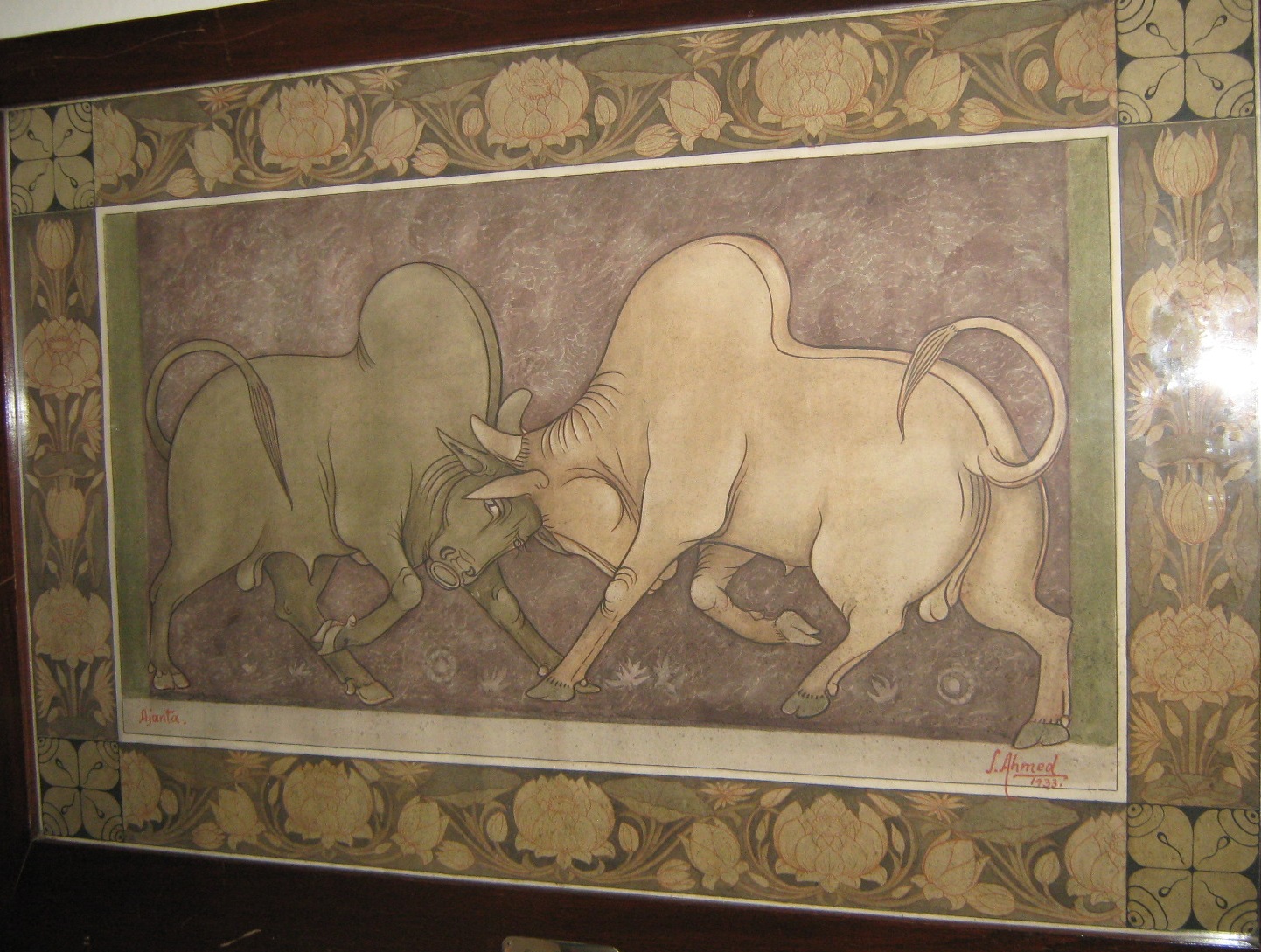
I will end by mentioning an Indian picture hang in a corridor: two bulls are fighting surrounded by a gorgeous border of water lilies, the image was probably originally created by Ajanta and copied here by S. Ahmed in 1933.
Tuesday, 20 April 2010
Joy and insanity in late 19th Century India

Today I have been generating metadata for the Lunatic Asylum annual reports of Madras, 1877-1891 which will be digitised over the summer. Reading the reports more closely is a favourite part of my job.
These present interesting details of how mental illness was treated in British India at the time. The causes of insanity were divided into two main groups, physical and moral.
Physical causes included narcotic drug use, epilepsy, fever, concussion, privation (deprivation) and over-study. Grief, love and jealousy, disgrace, fear, religion and vicious habit were listed as moral causes (1882-83).

Treatment of patients (typically called lunatics or insanes until around the 1920s)emphasised "occupation, out-door exercises, good food, occasional recreation and at all times careful supervision." (1881-82, W.R. Cornish, Surgeon-General).
Occupations consisted mostly of gardening and growing food, making mats and baskets for income generation, plus upkeep of asylum grounds and clothing.
Medicinal remedies are few, as A.N. Rogers Harrison wrote in 1881: "Little specific value is attached to the curative properties of medicines...however, opium and its derivatives, bromide of potassium, hydrate of chloral...together with counter-irritation and the cold and tepid baths are all remedies that have proved of distinct service."
The image of a chained or straight-jacketed Victorian inmate is dispelled when reading these reports. Indeed, "There is no restraint during the day, however violent the patient may be; these are simply watched. At night the noisy, violent, filthy are placed in cells by themselves." (H.D. Cook, 1881)
Funds were set aside for amusements, as in 1882: "At Christmas there was the usual treat, with sport, fireworks and a band. If this concentrated joy were distributed through the year, it would do more good. Native music, sweets, jugglers and a few fireworks once a month would, at a cheap rate, give pleasure to many." (S.L. Dobie)
I will be comparing these approaches with later ones as I go through the Mental Health collection, which dates to around 1940.
(picture credit: Wellcome Images, showing Lawrence Asylum, Ootakamund, Madras (1873) and Small images of men and children, all of whom show signs of insanity (undated))
Subscribe to:
Posts (Atom)


